




Indians have a strong saving habit with 83% of the adults surveyed currently saving or investing, where 80% use a digital platform and about 65% start the process by age 30, according to the ‘How India Saves 2026’ report.
The survey of 1,212 urban Indian adults across over 150 cities and towns by fixed-income investment platform Stable Money and global research data and analytics group YouGov noted that close to half of women savers now call the shots on household money, Gen Z is saving for a home, and Gen X is focused on retirement.
Mutual funds, fixed deposits vie for top spot
Respondents when asked about their preferred investment product answered as follows:
- 23% put mutual funds first choice, and
- 21% put bank fixed deposits (FDs) and recurring deposits (RDs) as their next preference,
- Notably, MFs and FDs / RDs take place of preference ahead of gold and silver (14%), equities (12%) and insurance or savings plans (10%).
- In terms of allocation: 56% place bank FDs and RDs in their top three, one point behind mutual funds (57%); and followed by gold and silver (45%).
- Rounding off the top five are insurance or savings plans (39%) and equities (36%).
Why FDs remain king of fixed income
As per the report, the near tie between mutual funds and fixed deposits indicates that savers as a group value both predictability and growth. “The platforms that earn the trust of Indian savers will be the ones that make every choice easy to understand, and honest about its terms,” it added.
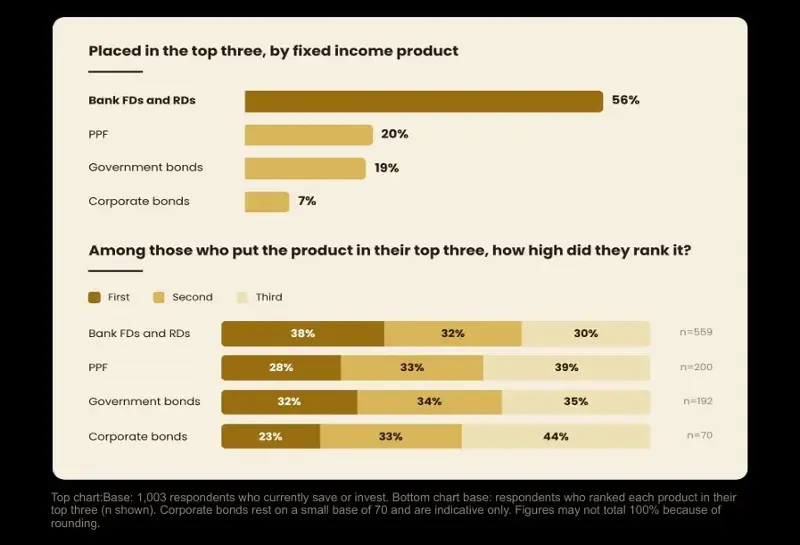
This is also visible when it comes to fixed income options, where FDs remain king and take top place, with a clear margin: 56% place bank FDs and RDs in their top three, nearly three times as often as the public provident fund i.e. PPF (20%), government bonds (19%) and corporate bonds (7%), as per the survey.
Among respondents, 21% name FDs their first choice, against 6% each for PPF and government bonds and 2% for corporate bonds.
Unexpected money? 87% would save, invest, clear debt
When asked what they would do with an unexpected lump sum, 32% said they would invest it in higher-growth options such as equities or MFs and 25% in a fixed-income product, so 57% would invest it.
Another 11% would reduce debt, so 87% would invest, save, or pay down debt with it. Only 13% would spend it: 8% on travel or an experience and 5% on a luxury purchase. Putting windfalls to work may reflect a response to the times.
Demographically, retirement leads overall, driven by Gen X. Priorities differ across generations: buying a home is the most-cited primary financial goal for Gen Z (26%), while 35% of Gen X respondents prioritise retirement.
For Gen Z, retirement ranks fourth, behind buying a home, building an emergency fund and travel. “In a sample made up largely of Gen Z and millennials, cohorts often stereotyped as financially impulsive, it is striking that long-term goals still feature prominently,” the study noted.
Among women surveyed, 46% say they primarily make household financial decisions themselves, and 29% decide jointly with a spouse or partner. This growing sense of financial independence may also be supported by greater access to information and digital platforms.
Disclaimer: This story is for educational purposes only. The views and recommendations made above are those of individual analysts or broking companies, and not of Mint. We advise investors to check with certified experts before making any investment decisions.