



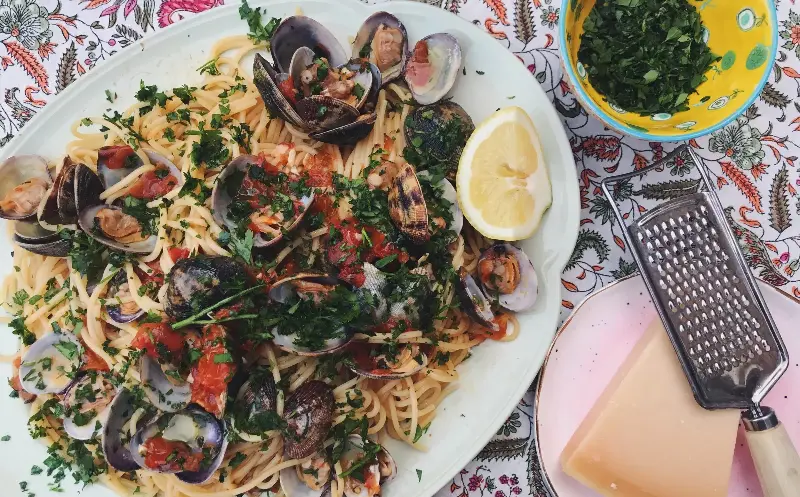
A heatwave in Italy is threatening one of the country’s most famous dishes, as extreme temperatures kill off mussels and clams.
Lagoons at the mouth of Italy’s longest river, the Po, have been turned into “gigantic cooking pots”, putting at risk spaghetti alle vongole, a cherished national dish which consists of clams, oil, garlic and parsley.
The temperature of the brackish water has risen to around 32C, which is too hot for clams to survive.
Clams and mussels are key ingredients in another prized pasta dish, spaghetti allo scoglio, which means literally “spaghetti from the reef”.
In the Sacca di Goro lagoon, at the mouth of the Po River, up to 90 per cent of clams have died, according to the farming and fishing association Confcooperative Agroalimentare e Pesca.
The high temperatures are reducing oxygen levels and encouraging the growth of algae.
The heatwave, which is seen as a consequence of longer-term climate-change trends in the Mediterranean, follows another existential threat to Italy’s clam and mussel fishermen: an invasion of blue crabs.
The Atlantic blue crab, which is named for its vivid blue claws, was introduced accidentally to Italian waters, probably in the ballast water of cargo ships.
It is thriving in the Adriatic, using its powerful pincers to tear into clams, mussels and prawns, and damaging fishing nets.
Fishermen have installed crab-proof fences in lagoons at the mouth of the Po, but they are limiting the flow of water, transforming the shallow stretches of water into “gigantic cooking pots”, according to the fishermen’s association.
This summer’s intense heat, coming on the back of similar heatwaves in recent years, is upsetting the balance of the marine ecosystem.
Warmer water is also threatening the survival of oysters, according to the Consorzio Cooperative Pescatori del Polesine, a consortium that represents fishermen working in the Po delta.
Climate change is causing £170m worth of damage to the fishing sector in Italy each year, the industry estimates.
The extended heatwave has resulted in a reduction of the River Po’s flow, meaning that salty seawater has advanced more than 10 miles inland.
The encroachment of saltwater is damaging crops, just weeks before they are due to be harvested.
Authorities are having to block irrigation canals to prevent the seawater from harming crops such as sunflowers, soybeans, rice and maize.
After two heatwaves in June and early July, Italy is in the grip of a third heatwave this week.
Temperatures are expected to reach 40C in many parts of the country, especially in the south and in Sardinia.
“Maximum temperatures will range between 39C and 41C across many areas of central and southern Italy and across all of Sardinia,” said Federico Brescia, a leading meteorologist.
Florence is expected to bake in 39C while Rome will be nearly as bad, with temperatures of 38C forecast.