



After visiting Portofino in 1947 and 1948, my late father wrote in his travel notebook: “Albergo Splendido. First rate, but very expensive.” He doesn’t record how much it cost, but the 1953 edition of the Blue Guide to Northern Italy gives a price of 1,200 Italian lira a night, which was around 69p, or £25 in today’s money.
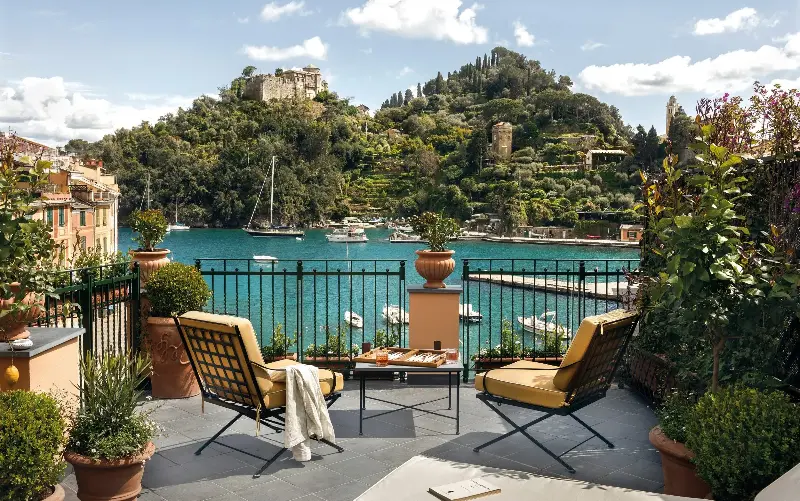
A stay at the Hotel Splendido in 2026? Well, you’re looking at a starting rate of about £2,000 a night, or £3,000 if you want to come in peak season. The views are certainly five star, looking down to the village of Portofino where gelato-coloured houses surround a tiny harbour and beyond it a wooden peninsula. Boats, both yachts and the tiny passenger ferries that head up and down this part of the Ligurian coast, seem to co-exist quite happily.
And then there is the hotel, which is an experiential hit to the senses: from the marble and jasmine-studded pathways that lead to a swimming pool and tennis court, to the restaurants perched on the hillside and the cocktails that come on tiny white linen coasters embroidered with the Splendido’s emblem of two seahorses. It recently emerged from a multimillion-pound, three-year renovation.
The notion of dolce vita, connecting to the simple pleasures of life, took hold in the early 1950s as Italy recovered, with significant help from the aid given by the US Marshall Plan, from the Second World War. Top hotels today such as Le Sirenuse in Positano and Casa Angelina, a little further along the Amalfi Coast, all started life as tiny guesthouses. The bones of the Splendido are grander than these former pensiones though. It was initially built in the 16th century as a monastery and became a hotel in 1901.
In the 1950s, Ava Gardner and Humphrey Bogart stayed when filming The Barefoot Contessa. Other guests from that era included Princess Grace of Monaco, Clark Gable and Groucho Marx (“Wonderful hotel, wonderful people. I deeply regret leaving,” he wrote in the visitor’s book in 1954) while Elizabeth Taylor made multiple visits with several husbands.
But before all this glamour came my 26-year-old father. In 1947, he would have been at the University of Oxford, in the middle of a degree that had been interrupted by being called up in 1940.
When he stayed, my father would have almost certainly been accompanying his never-easy mother. After spending the war years with her sister’s family in a draughty manse house on the Scottish coast, she would have been yearning to return to a place of free-flowing aperitivi. For my grandmother, who had scandalised Roman locals by swimming in the Tiber river in the 1930s, swapping the North Sea for the Med, even if only temporarily, must have felt magical.
Instead of Britain’s strict post-war rationing, the fruit trees would have been laden with peaches and apricots while the first full post-war harvest of olive oil would have come in generous glugs over sun-ripened tomatoes and deeply scented basil. Portofino’s fishing boats would have been producing everything from lobster to tuna, while it’s safe to assume that wine – squirrelled away during the war from the occupying German forces that had used Portofino as a naval base – was also available.
How did my father feel, I wonder? Like many of his generation, he didn’t talk about the war, but he had taken part in the Invasion of Sicily in 1943, and earlier, in 1941 in Malta, had experienced waves of bombing from the Italian island of Pantelleria. His younger brother had died near Caen, soon after D-Day, and I suspect he was embracing the notion of peace.
Arriving at the Splendido, the transformation of which was overseen by designer Martin Brudnizki, made me feel as if I’d been transported to a 1940s-accented heaven. With muted shades of blue, pink and green, with a bare minimum of gilding, the rooms are gentle and supremely comfortable. Their number has been reduced from a total of 70 to 20 rooms and 41 suites. Everywhere there are books and cherished bits of the hotel’s original furniture.
A squadron of craftspeople has performed gentle surgery throughout the hotel. Nowhere more so than the new Baratta Sedici, with its curved white onyx bar surrounded by hand-painted murals and newly laid, highly intricate Graniglia alla Genovese mosaic flooring. The cushions are tasselled and snacks arrive on hand-painted dishes from just along the coast in Albisola. After a cocktail or two, this place starts to feel like the Marshall Plan of hotel redesigns – hopeful and all about the locale.
There are some new touches of internationalism, including the first permanent Dior Spa in a Belmond hotel (Belmond is now part of the luxury LVMH group, which also includes Dior) and my massage was predictably excellent but, just as relaxing, is the sheer Italianness of simply being there. Even a sudden downpour one evening was magical as we sat in La Terrazza restaurant.
My meal began with a stuffed courgette flower, resting on a pillow of whipped ricotta encased in a delicate batter, before progressing to trofie pasta, which comes from just along the coast, accompanied by Ligurian pesto with San Rossore pine nuts and a 30-month-aged Pecorino cheese.
Just above the Splendido is La Portofinese, a three-hectare farm that has been hewn from wilderness in the past decade. When I visited, its stepped terraces were full of grape vines, laden with fruit growing alongside tomatoes, basil and citrus trees. Just as I presume happened after the war, its wine flows into the Splendido below, although now it’s from highly prized Vermentino grapes harvested with renewable energy. La Portofinese’s honey – still in combs that have an extraordinary depth of flavour – takes pride of place at the Splendido’s breakfast buffet.
My father didn’t return to Italy for several decades after this trip. But with every tricolore salad he made, growing his own tomatoes and basil and heading into Soho to buy mozzarella then dousing it all in the best olive oil he could find (first from the chemist, then delicatessens and finally – in the 1980s – supermarkets), it’s safe to say that Portofino and the Splendido took on a highly contented, peace-infused place in his head.
Sarah Turner travelled as a guest of the Belmond Splendido (0039 0185 2353 00), which offers doubles from £2,110, including breakfast.