



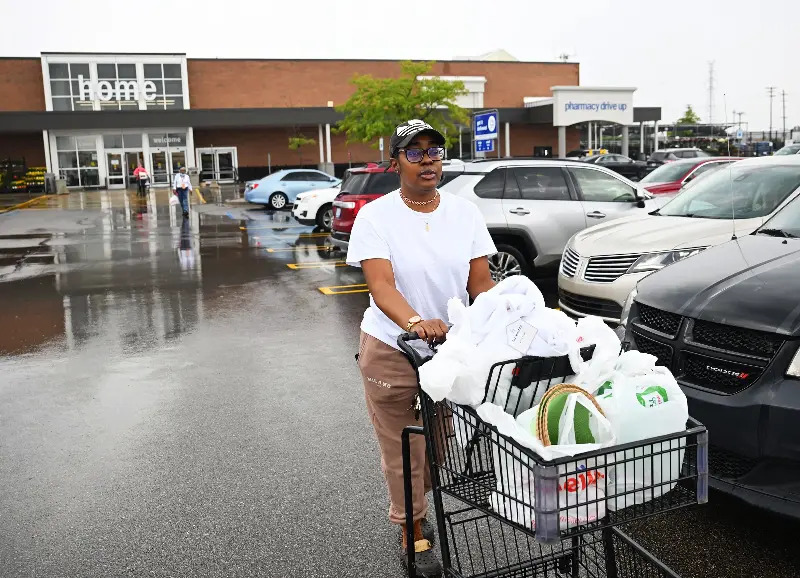
DETROIT — When Olivia Miller needs to stock up on groceries, she often heads out of the city.
The 34-year-old Detroiter said she drives about 15 minutes from her west-side neighborhood to Livonia to shop at Meijer. The reasons: She can find more of what she needs there, and some neighborhood grocery stores have higher prices and a smaller selection.
“If I can drive away and go shop somewhere cheaper," she said, "I'm going to do that.”
Miller’s shopping routine — and that of other Detroit residents who leave the city to shop — is one that the city is trying to address as it steps up efforts to attract more retail, including national and regional chains. Detroit officials estimate residents spend more than $3 billion a year in surrounding communities on retail goods and services they can't easily find where they live.
The goal is to provide convenience and keep more of Detroiters' money in town. “We need to show that Detroiters have real running capital, and it's important for us to flex that as much as we can,” said Addofio Addo, the city's recently hired director of retail attraction.
The type of retail Detroit attracts is important, said Stephanie Leiser, director of the Center for Local, State, and Urban Policy at the University of Michigan's Ford School of Public Policy.
Grocery stores and other everyday retailers are a better measure of progress than some of the higher-end stores that have recently opened downtown, she said: “I think that the grocery element in particular is more of the thing that I would be looking at and seeing as an indicator of real progress, rather than some of the more like upscale retail.”
Leiser said Detroit has seen some positive signs, including new grocery options and other retail openings. However, it's too early to know how sustainable some of the newer businesses will be.
To build on that, earlier this year the city created the director of retail attraction position and this summer hired Addo, a former Bedrock executive, to recruit national brands, regional retailers and grocery stores to neighborhood commercial corridors.
While the city wants to draw in national retailers, it also wants to balance that with attracting and growing local businesses.
“My approach actually is in line of curating a nice retail mix,” Addo said. “We want to make sure that we amplify the businesses that are already taking shape here, but then making sure that we mix it with other national brands to get community sense of retail.”
Addo said that mix should include both everyday necessities and retailers that add to the character of a neighborhood.
“Yeah, I think when it comes to need, there's always a need for essential goods, right?" he said. "I should be able to get a white T-shirt for six bucks, you know. But I also think there needs to be a healthy mix of, you know, placemaking. Brands that bring in a specific culture of people that already exist in the city, brands that make people want to stay in the city.”
What Detroit residents want
Detroit covers about 139 square miles, with retail spread across neighborhoods and commercial corridors. The mix includes liquor and convenience stores, beauty supply shops, barbershops and salons, cellphone stores, bars and restaurants, auto-related businesses and other small retailers, along with grocery stores and pharmacies.
The city has a limited number of large national retailers. Home Depot, Whole Foods and Marshalls each have one Detroit location, while Meijer has three and Aldi has two.
There has been growth in national and regional retail outlets downtown in recent years, with the arrival of Apple, Tecovas, GW Home, Timberland and Free People. But Detroit has also lost national retailers, including Madewell, Under Armour and Moosejaw. And plans for a small-format Target store in Midtown were scrapped in 2024 after the company cited delays and complications.
In steps Addo, who is tasked with helping the city close some of those retail gaps and bring more national and regional brands to its neighborhoods and commercial corridors.
Addo came to the position with experience attracting businesses and major events to Detroit. As director of business development in arts, culture and business attraction at Bedrock, he used culture as an entry point for global names arriving in the city. His work included attracting Rihanna’s Savage X Fenty brand to Woodward Avenue and working with Apple on cultural programming and partnerships surrounding its downtown opening in September 2025.
Now through his new role, Addo is taking a broader look at Detroit’s retail landscape, he said: “Mapping the whole city and being intentional about how we start, where we start, especially in this first year, is going to be crucial."
For residents, the question is whether the city's efforts will translate into more affordable, convenient options near their homes.
Miller said the lack of neighborhood options can mean driving 15 to 20 minutes when she needs groceries, or like during a recent shopping trip, to pick up towels and other home goods. She said she has the ability to leave Detroit for lower prices, but not everyone does.
“So I understand that I have the privilege to drive outside of Detroit and go get cheaper groceries, but there's a lot of people here who don't have that privilege because they don't have the transportation to get, you know, 15-20 minutes away to Livonia or Westland, Canton, etc.,” she said.
Keion Franks, a 23-year-old west side Detroit resident, said he would like to see more value-oriented retailers in city neighborhoods, particularly grocery stores. He switched to Aldi in Redford Township after relying on neighborhood grocery stores that he said can be more expensive.
“I switched over to Aldi's because I can honestly afford Aldi's,” he said. He would like to see more stores such as Aldi and Save A Lot in Detroit, giving residents more choices closer to home.
The city's strategy
Addo's office is taking a collaborative approach to retail attraction. In addition to working with the Detroit Economic Growth Corp., he talks with city departments, developers, landlords, business owners and businesses outside Detroit.
He also talks with businesses that are both succeeding and struggling to better understand the challenges retailers face and identify ways to improve the city's retail environment. National retailers first want to understand data on the city, including demographics and other market metrics. But he said those numbers don't always tell the full story.
“A lot of the retailers that I have brought here in the past, they fall in love with the city, especially if they stay more than 24, 48 hours,” Addo said.
The city also needs to make it easier for retailers to open, including helping businesses understand available incentives, he said: “What are some of the incentives that I'll be able to gain from being in this particular city?”
For example, the DEGC runs the Motor City Match program, which provides financial and technical support to small businesses and startups opening in commercial corridors. And then there's the Green Grocer program, which aims to bring fresh food and grocery options to underserved neighborhoods.
Addo said his goal is to have “an active department and team that's truly trying to create a white-glove service for you to open a business ASAP.”
He also said he wants the city's retail strategy to start with neighborhoods and the people who live in them.
“I believe in a 'neighborhood first' approach because they give you the most honest answers in terms of what people actually need, and I think if we build it together, that's what makes it exciting. That's what makes it unique from other cities.”
But attracting more retailers will take more than convincing businesses to come to Detroit, said Keion Harris, a Detroit native and University of Michigan Ph.D. candidate whose research focuses on fiscal and social policy.
Harris said retailers look at income and population when determining whether they can make a return on investment. He also pointed to structural barriers, including property taxes and insurance costs, that can make it more difficult to attract retailers to Detroit.
"It can't just be on the director of retail," he said.
He said the effort would need to include the mayor's administration, private-sector partners and the state government, particularly when it comes to property tax reform and potential changes to the city's tax structure.
Detroit also needs to change the way retailers view the city's spending power, Addo said: "I think that's going to be the sounding alarm for a lot of retailers, but it'll be the sounding alarm for the state."
The landlords leasing commercial spaces also have a role in shaping Detroit's retail mix. For real estate firms such as Bedrock, attracting retail is a long-term process, said Jennifer Skiba, vice president of retail leasing at Bedrock.
“We will hold spaces to bring in the right uses,” she said. “Really the retail attraction is a long game for us because we want to ensure the city's viability for generations and centuries to come.”
Many brands have been watching Detroit for years, Skiba said, and "they realize now that the timing is right for them to enter the market."
Jeff Horner, a lecturer in urban studies at Wayne State University, said neighborhood retail provides what he calls a "use value," such as being able to walk to a grocery store or other businesses. He said that matters especially for seniors and residents who don’t want to drive or can’t easily do so.
Horner said the focus should be on locally owned retail because it keeps more money circulating in the community. Detroit could make the market more favorable to locally owned businesses through incentives and potentially tax policy, he said.
“You not only want to spend locally, but the reason that you're encouraged to spend locally is so the money stays local.”
Horner said that while large national retailers provide jobs and goods, much of the money spent at those stores leaves the city and often the state, benefiting corporate owners and shareholders elsewhere.
Detroit should build density, he said, and retail will follow: "The retail will not come to any city until people are there first."